Nature
 PUBLISHED
 5
5


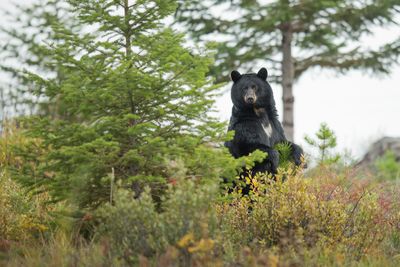


In sad news for fans of urban folklore, Bigfoot could actually be several hundred black bears, a new analysis suggests. It seems people across North America may have been mistaking the American black bear (Ursus americanus) for everyone’s favorite giant hairy ape-like creature all these years.
The rest of this article is behind a paywall. Please sign in or subscribe to access the full content.The analysis, poetically titled “If it’s there, could it be a bear?” and yet to be peer-reviewed, attempts to use statistics to try and explain the enduring myth, coming to the conclusion that “if bigfoot is there, it may be many bears.”
How many exactly? For every 900 black bears in a given state or province, one Bigfoot sighting is expected, writes study author and data scientist Floe Foxon.
Bigfoot, also referred to as Sasquatch, is the supposed bipedal ape found roaming, it is rumored, in the forests of North America. The legend spans back to the 1800s and in the centuries that have followed, there have been countless alleged sightings and even some “discoveries” (some more questionable than others) claiming to have solved the myth.
The American black bear has been suggested as a potential candidate – after all they are sufficiently large, hairy, and known to occasionally walk on their hind legs – and has previously been the subject of studies based in the Pacific Northwest aiming to explain the sightings.
Foxon’s analysis extended this range to the entire US and Canada, using statistical methods to identify a link between Bigfoot sightings (as per the Bigfoot Field Researchers Organization) and black bear populations.
“After adjusting for human population and land area, one sasquatch sighting is expected for every few hundred bears in a given state or province,” Foxon writes, adding that the association was statistically significant.
“The most likely explanation is therefore that many Bigfoot sightings are really sightings of the black bear, which makes sense because bears do occasionally walk bipedally with their hind legs, so they can look a bit like giant apes,” he told The Telegraph. “The bear explanation for Bigfoot is very likely.”
It’s been quite the month for Foxon's mythical monster revelations: recently he demonstrated that Nessie probably isn’t a giant eel. So while our Bigfoot hopes might be dashed, the Loch Ness legend lives on. Although the chance of finding either is “vanishingly unlikely”, Foxon told the Telegraph, it “would be arrogant to say there is no chance”.
The preprint is available at bioRxiv.