Space and Physics
 PUBLISHED
 5
5


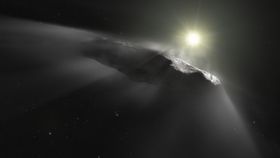


In October 2017, astronomers discovered a peculiar object in the Solar System. Its trajectory and speed suggested that it came from a different star system entirely. It was named 'Oumuamua, which translates as "scout" in Hawaiian, by astronomers at the University of Hawaii's Institute for Astronomy, where it was first observed. Over the few weeks that it was visible it revealed many other peculiarities, which led some scientists to speculate that our first interstellar visitor may actually be artificial in origin.
The rest of this article is behind a paywall. Please sign in or subscribe to access the full content.That idea, however, was dismissed by most astronomers as a nebulous solution to a complex question, one that required very little explanation. “It’s aliens!” is an effective approach to glossing over that which we do not know. Just to be sure, however, researchers have looked for several signatures that may indicate evidence of extra-terrestrial technology and came back empty-handed.
The International Space Science Institute ‘Oumuamua team points out in a new paper published in Nature Astronomy, that the while the alien spacecraft is a “fun idea”, everything seen so far can be explained by natural phenomena, and so it is much more likely it has a natural origin. That's not to say we know everything about the object, but just because ‘Oumuamua doesn't act like anything else in our Solar System, doesn’t mean there are little green people behind it.
"We put together a strong team of experts in various different areas of work on 'Oumuamua. This cross-pollination led to the first comprehensive analysis and the best big-picture summary to date of what we know about the object," corresponding author Matthew Knight, from the University of Maryland, said in a statement.
Among ‘Oumuamua's many peculiarities, its shape and rotation jump out. It's an elongated cigar-like object spinning around its longest axis. It also seems to have accelerated as it crossed the Solar System. This is not particularly unusual, comets experience that, but ‘Oumuamua has none of the major outgassing hallmarks of cometary bodies.
"We have never seen anything like 'Oumuamua in our solar system. It's really a mystery still," Knight said. "We tend to assume that the physical processes we observe here, close to home, are universal. This thing is weird and admittedly hard to explain, but that doesn't exclude other natural phenomena that could explain it."
The object is now too faint to be studied, so our understanding of it will only expand as we learn more about these interstellar visitors. Some statistics suggest up to 10,000 of these small rocks are within our Solar System at any given time, and with telescopes like as the Large Synoptic Survey Telescope (LSST) coming online in the next three years, we will start seeing more of them.
"In the next 10 years, we expect to begin seeing more objects like 'Oumuamua. The LSST will be leaps and bounds beyond any other survey we have in terms of capability to find small interstellar visitors," Knight said. "We may start seeing a new object every year. That's when we'll start to know whether 'Oumuamua is weird, or common. If we find 10-20 of these things and 'Oumuamua still looks unusual, we'll have to reexamine our explanations."