Nature
 PUBLISHED




Humans love alcohol. We’ve made a global market out of taking things and letting them get old in just the right way that it gets us absolutely cabbaged. Funny thing is, we’re not the only animals partial to a tipple.
The rest of this article is behind a paywall. Please sign in or subscribe to access the full content.It was announced earlier this year that wild chimps have clinically significant levels of alcohol in their urine from eating rotten fruit. That’s nothing compared to hamsters, however, who can quaff the equivalent of 21 bottles of wine a day (albeit under experimental conditions, even if they didn’t need much encouragement).
Now, new research has shown that even some of nature’s smallest critters are naturally exposed to significant amounts of alcohol on a daily basis. Their poison? Nectar.
The discovery came about through several investigations. The first made use of a feeder outside the office of Robert Dudley, a University of California, Berkeley, professor of integrative biology.
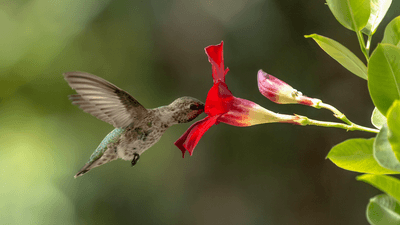
Dudley is familiar with the Anna’s hummingbirds (Calypte anna) that visit his feeder each day. What he didn’t know was if they could be swayed by a little extra sauce in their sugar water.
When the alcohol in the sugar water was less than 1 percent by volume, they visited the feeder twice as often as they did when that alcohol was increased to 2 percent.
“Somehow they are metering their intake, so maybe zero to 1 [percent] is a more likely concentration that they would find in the wild than anything higher,” he said in a statement.
The next experiment looked at the birds’ feathers to see if they could find evidence of alcohol consumption in the form of ethyl glucuronide, a metabolic byproduct of ethanol. The results revealed the birds to drink ethanol in their nectar, and they metabolize it similarly to how we do.
Then, it was time to figure out just how much a bird is consuming based on their known nectar diet. They tested 29 species of plants and found that at least one flower contained detectable levels of alcohol for 26 of those tested. These included plants three species of South African sunbirds are partial to, and their results, along with the hummingbirds, were compared against estimates for the European honeybee, pen-tailed tree shrew, fruit-eating chimps, and booze-loving humans.
The shrew came out on top, consuming the most alcohol a day, whereas the bee consumed the least. The nectar-feeding birds were about the same, but it seems the hummingbirds may get more of a kick from fermented sugar in feeders compared to fermented nectar in flowers. Still, it can add up.
Like other hummingbirds, the Anna’s hummingbird consumes between 50 percent and 150 percent of its entire body weight in nectar every day. The authors estimated that amounts to 0.2 grams of ethanol per kilogram of body weight per day, which is the equivalent of a human drinking a small beer. Something tells me Benicio del Toro would approve.
So, does this mean Anna’s hummingbirds are committing the unthinkable and driving drunk? What we know of their furnace-like metabolisms suggests probably not, but there could be other definitions of “under the influence” for these animals.
“There may be other kinds of effects specific to the foraging biology of the species in question that could be beneficial,” said Dudley. “They're burning it so fast, I'm guessing that they probably aren't suffering inebriating effects. But it may also have other consequences for their behavior.”
The study is published in the journal Royal Society Open Science.