Space and Physics
 PUBLISHED
 2
2




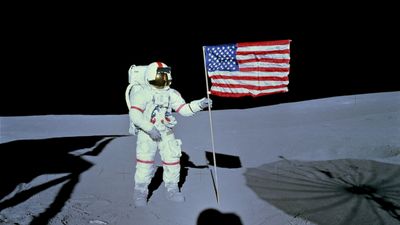


In 1967, two years before humans walked on the moon, the United States, the United Kingdom, and the Soviet Union signed the Outer Space Treaty. This short document underpins how nations should behave in space. In the first article, it is explicitly stated that the exploration of space shall be carried out for the benefit of all countries and shall be the province of all mankind. So imagine our surprise hearing a Fox News host claiming that the Moon belongs to the US.
The rest of this article is behind a paywall. Please sign in or subscribe to access the full content.The claim was uttered by Fox News host Jesse Watters on January 20 in a wider comment on imperialistic expansion of the United States, related to the Trump administration's threats to invade Greenland, a territory belonging to Denmark.
“We have to secure Greenland. It will happen. Dana is right. She's never been wrong in any of her predictions. The United States always secures our interests, economically, militarily, either by force or purchase. Louisiana Purchase. Alaska. The Philippines. We even got the Marshall Islands after World War II. You don't even know where they are, Greg. We got the moon. I think we own it. And — I know we own it,” Watters said, while some in the studio laughed.
The Fox News host has already been ridiculed online for the claim. The Moon doesn’t belong to any one nation or individual, and if that were the case, the Catholic Church could also have some claims!
Article II of the Outer Space Treaty states clearly that “Outer space, including the moon and other celestial bodies, is not subject to national appropriation by claim of sovereignty, by means of use or occupation, or by any other means.”
There are some issues to discuss, though, and this is why we felt that this obviously false claim could benefit from some contextual points. The looseness of terms in the Outer Space Treaty means that different countries can and have interpreted it in different ways.
“President Obama signed a law in the United States in 2015 that said we, the United States, interprets the Outer Space Treaty Article 2 to say you can't claim territory but if you extract the resources, then those are yours,” Professor Michelle Hanlon, co-director of the Air and Space Law Program at the University of Mississippi School of Law, told IFLScience when we were trying to start our own fictitious space civilization.
So far, a few countries have brought back lunar rocks for scientific purposes. No one has yet set up a mining operation on the Moon. But if they did, would that be a territorial claim? Could another country set up a similar operation right next to it?
This is the idea that countries should be able to establish a perimeter for the safety of operation. Let’s say that a nuclear reactor for the Moon is finally developed, or a regular launchpad is built. It makes sense that the area is restricted in the interest of safety. Is that a territorial claim?
The Outer Space Treaty is almost 60 years old, and space exploration has massively changed since then. It badly needs updating, ideally before somebody actually claims a bit of the Moon for themselves.