Nature
 PUBLISHED
 4
4




While fossilized plants turn up fairly often in the fossil record, they are usually preserved as a trunk or the odd leaf, giving little idea of what the whole tree might have looked like. Newly discovered fossilized trees from New Brunswick, Canada however have enough in the record to reveal that they had a very surprising appearance that has never been seen before.
The rest of this article is behind a paywall. Please sign in or subscribe to access the full content.“The way in which this tree produced hugely long leaves around its spindly trunk, and the sheer number over a short length of trunk, is startling,” said Robert Gastaldo of Colby College in Waterville, Maine in a statement.
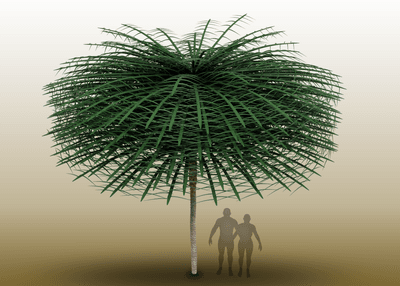
Ferns and palm trees are seen in the fossil record – and while this new plant resembles a palm, Sanfordiacaulisis is thought to be 350 million years old, which outdates the existence of palms known in the fossil record by 300 million years. Palm tree leaves usually cluster at the top in small numbers, but the new fossil tree is thought to have had over 250 large leaves not just at the top of the plant but growing around the trunk too.
“Sanfordiacaulis preserves more than 250 leaves around its trunk, with each partially preserved leaf extending 1.75 meters from it,” Gastaldo said.
The tree had a trunk of around 16 centimeters (6.2 inches) in diameter, with leaves that started growing around the trunk in a spiral branching pattern with very dense growth, resulting in a voluminous crown at the top of the tree.

“We estimate that each leaf grew at least another meter before terminating. This means that the ‘bottle brush’ had a dense canopy of leaves that extended at least 5.5 meters (or 18 feet) around a trunk that was non-woody and only 16 centimeters (or 0.5 feet) in diameter. Startling to say the least,” said Gastaldo.
The team thinks that the fossils were preserved because of an earthquake that caused these trees to be buried along the margin of a rift lake. One specimen was discovered seven years ago, and now four more complete specimens of the same plant found nearby have been unearthed as well. One of the specimens shows how the leaves departed from the tip of the tree.
“Any fossil tree with an intact crown is a rarity in the history of life,” Gastaldo said. “Having the crown leaves attached to a trunk, by itself, begs the questions what kind of plant is it, how is that plant organized, And is it some form that continues to the present, or is it outside of the ‘normal’ concept of a tree? All of these questions, and more, led to this multi-year endeavor.”
Why the tree might have had such an unusual leaf arrangement is still up for debate. The researchers think it could be that the leaves were so long in order to capture as much light as possible so the plant could outcompete other smaller plants in the same habitat. The team thinks this is some of the earliest evidence of trees growing at different levels, known as sub-canopy-tiering.
“The history of life on land consists of plants and animals that are unlike any of those that live at the present,” Gastaldo said. “Evolutionary mechanisms operating in the deep past resulted in organisms that successfully lived over long periods of time, but their shapes, forms, growth architectures, and life histories undertook different trajectories and strategies. Rare and unusual fossils, such as the New Brunswick tree, is but one example of what colonized our planet but was an unsuccessful experiment.”
This spectacular and unusual fossil reveals that vegetation in the Early Carboniferous was much more complex than previously thought. If you can't get enough of plants doing something a bit unexpected, check out these zombie ferns.
The paper is published in the journal Current Biology.