Space and Physics
 PUBLISHED



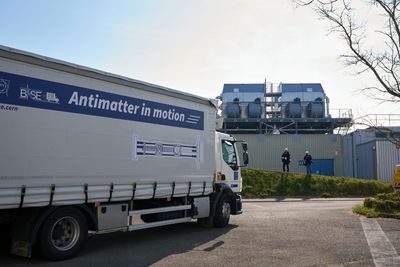


Every fundamental particle of matter has a mirror image with opposite properties: antimatter. The known laws of physics don't explain why the universe is made of one and not the other, and the quest to solve this crucial mystery is very much ongoing. This week it took a leap forward: on the back of a truck!
The rest of this article is behind a paywall. Please sign in or subscribe to access the full content.Scientists at the BASE collaboration at CERN’s Antimatter Factory, have transported antimatter by road for the first time ever. The team placed 92 antiprotons in a special Penning trap, a device that can confine electrically charged particles, and this BASE-STEP Penning-trap system was then loaded at the back of a truck and sent around the CERN campus.
In total, the drive was 7.5 kilometers (just over 4.6 miles), which is roughly twice the largest route one can do around the premises without leaving CERN. It was an incredible success.
“Initially, we agreed we’d do one round and turn back,” Marcel Leonhardt, graduate researcher and team member of BASE, told IFLScience. “But everything went so well that we were like, ‘Hey, come on, let's do a second round!’ So we did two, came back, counted the particles, and there were still 92 antiprotons in the trap.”
“It did not just work barely, it worked perfectly! Everything just functioned; everything just went as planned. At that point, we opened the bottles of champagne and celebrated because it was the first transport of antimatter ever!”
The truck was emblazoned with the phrase Antimatter in Motion, but the team tells us that during its first lap of the campus, nobody seemed to notice what was happening. It was only on the second round that people started taking some pictures of it.
“For people from the outside, it was a regular truck just driving in a circle,” Leonhardt continued. “But for us, it was really years and years of preparation, work, fears that something might go wrong, fears that we have missed some fundamental thing that we should have thought about, and hours and hours of preparation, nights that we worked through and took care of the particles.”
The team tested the setup last year by moving regular old protons around; an important dress rehearsal showing that this was indeed possible. Demonstrating that antimatter can be moved without losing any particles is a monumental achievement, and it marks a step towards delivering the precious and difficult-to-produce substance far away from CERN.
The Antimatter Factory is a truly phenomenal place where, on top of the production of antiprotons, a lot of other cutting-edge research on antimatter takes place – but it has one major problem. The measurements we make of antimatter are of such a high level of precision that the presence of so many particle accelerators nearby (despite all the shielding) produces noise and uncertainties in the observations.
“I recently did a rough calculation of how long we would need to make better measurements while the accelerator is on in the accelerator hall. And I ended up at an estimate of something like seven years per measurement,” Professor Stefan Ulmer, a BASE collaboration spokesperson, told IFLScience last year.
So the idea is to collect antimatter, put it on a truck, and take it somewhere a lot more quiet, massively reducing the uncertainties about its properties. One such place is Heinrich Heine University Düsseldorf, where a lab is being set up to conduct those very high precision measurements.
The test showed that the BASE-STEP Penning-trap system works perfectly for at least four hours. The team didn't want to explore its true hard limit, as antiprotons are very precious, and they didn't want to waste them. Still, the 800-kilometer (500-mile) journey to Düsseldorf can’t be made in that time frame, even on the notoriously speedy German Autobahn.
The team is investigating additional components for the equipment inside the truck that would extend the time limit, and they also plan to increase the number of antiprotons in the trap to 1,000. There is no rush to get to Düsseldorf, however, as the lab is still under construction, so the team will continue to test locally, including going to CERN sites that are off campus.
This is an incredible scientific and engineering feat, so of course it can’t be appreciated without some people freaking out about the end of the world. Antimatter does annihilate when in contact with regular matter, meaning it turns into pure energy. Theoretically, this could be dangerous, but not in the quantities we can produce. Half a gram of antimatter could level a city, but it would take humans 500 million years to produce that much with our current technology.
“The most dangerous thing in this entire transport is that the truck will have an accident, because the gasoline in the truck tank is a million times more dangerous than the antimatter,” Professor Ulmer told IFLScience.
Leonhardt, who has a background in medical physics, went a step further and estimated just how much energy would have been released if the trap had failed, concluding that it would be about 30 nanojoules.
“To fire a neuron, it takes one nanojoule. With the energy of annihilating 100 antiprotons with 100 protons, you could fire 30 neurons,” Leonhardt told IFLScience.
“If you think: ‘What could possibly go wrong?’ you're already activating more neurons than you could power with this… just thinking about it would already be a waste of energy!”
So, once again, it appears the end of the world isn't about to begin at CERN, especially since the transport went flawlessly, so not even one of the antiprotons annihilated. We can’t wait to see what the BASE collaboration achieves next. Maybe soon, antimatter deliveries will be made to labs all over Europe.
Correction: An earlier version of this article used an unofficial name for the modified Penning trap. The way in which researchers will modify the system to improve the transport time limit has also been clarified.



 1
1