Nature
 PUBLISHED



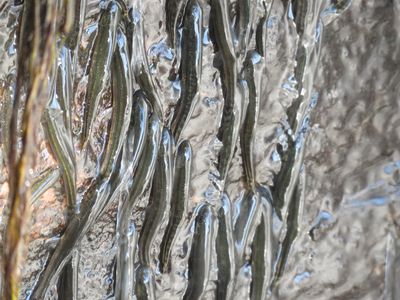


In the Democratic Republic of the Congo, researchers have discovered something extraordinary: behind the raging waters of a scenic waterfall are thousands of tiny fish that don’t swim but climb up the slippery 15-meter-high rocks on an arduous 10-hour journey.
The rest of this article is behind a paywall. Please sign in or subscribe to access the full content.These are shellear fish (Parakneria thysi), climbing the harsh vertical walls of Luvilombo Falls. Scientists recorded this behavior four times in 2018 and 2020. Only fish measuring between 3.7 and 4.8 centimeters (1.4 and 1.8 inches) seem to attempt the journey, which they embark on at the end of the rainy season.
This behavior has been known anecdotally for around 50 years but hadn't been scientifically reported until now. The fish’s name in the local language of Sanga is “kalumba” from the verb “kulumba” meaning “to stick”.
Remarkably, other fish – such as the tiny bumblebee catfish – have also been seen climbing, but they use their mouths to do it. The shellears, by contrast, cling to the rock surface with their fins; both their pelvic and pectoral fins have tiny, hook-like projections that help them to shimmy their bodies up the 15 meter (49 feet) walls.
The researchers found that the average fish took 9 hours and 45 minutes to complete its journey. But this time was almost entirely taken up by resting, including nine hour-long breaks and 30 minutes of short pauses, making for just 15 minutes of movement in total. It seems the shellears aren’t in a rush.
The long pauses were taken on horizontal ledges, allowing the fish to fully rest rather than taking a short break while holding on with their fins. Large numbers of fish congregated on these ledges before setting off on the next stage of their ascent.
At the beginning of April, thought to be the start of the migration period, not many shellears have yet decided to try the climb. This is when the water level is at its highest for the month. From that point onwards, however, their numbers increase, reaching a peak in mid-April, when the water level has fallen back to the average.
The migration period is thought to end in early May, when the water level drops at the end of the rainy season. The fish also seem to prefer to migrate between 4 and 6 pm, coinciding with sunset, while the lowest numbers were seen around sunrise.
The team think the timing is linked to rainfall, as the climbing shellears could be washed downstream earlier in the season because of heavy rain. Other theories are that they are looking for areas with less competition for food or attempting to escape the predatory silver butter catfish (Schilbe intermedius).
Shellears are also subject to humankind’s effect on the area. Fishing is common there, and the tiny shellears can be caught by mosquito net sieving, despite this technique being against the law. The water in the river is also used to irrigate the land, which can dry out the downstream section completely. The paper authors call for more strict protections for the river, the falls, and their occupants.
The paper is published in Scientific Reports.