Space and Physics
 PUBLISHED



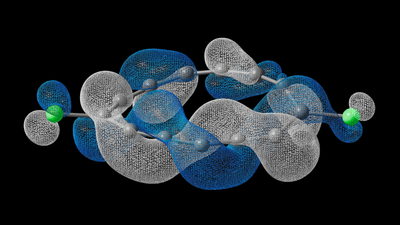


For the first time a molecule has been created that is twisted half-way to a Möbius strip shape, causing its electrons to move in a spiral like a corkscrew that alters its chemistry, and can shapeshift into three forms.
The rest of this article is behind a paywall. Please sign in or subscribe to access the full content.The Möbius strip is a demonstration of how a simple geometric modification can upend our usual intuition about the world. A strip of paper or material is twisted and its ends are attached together, producing an object that only has one side. The strip is so easy to make that the Romans knew about it, long before paper reached Europe, but making one out of a single molecule is a very different matter.
Some Möbius-shaped hydrocarbon molecules have been reported, but researchers from five universities and IBM went one better, creating not the familiar Möbius strip, but a half-Möbius, where the twist is 90 degrees rather than 180 degrees.
In a traditional Möbius strip, if you trace along its surface you need to go around the loop twice to return to the starting point – this is in contrast to a simple shape, where this can be done in one circuit. In a half-Möbius, only by going around four times can you return to your point of origin.
The molecule’s chemical formula is relatively simple (C13Cl2), but the researchers had to put it together atom by atom using an atomic force microscope, rather than simply mixing up the appropriate elements and letting nature take its course. More precisely, chlorine atoms were removed one-by-one from a C13Cl10 precursor on a layer of gold using short pulses of voltage.
Being a molecule, instead of that journey around the loop being traced with a pen, it is made by a cloud of electrons that, were they conscious, would presumably be very dizzy by the time they’d made it back to their point of origin.
One fascinating property of some molecules is they can exist in different forms despite having the same connectivity between their atoms, a phenomenon called chirality or handedness. One example of this is left- and right-handed forms of drugs, and it's possible that we could produce whole organisms with opposite handedness, to potentially disastrous effect.
The half-Möbius molecule can take on three forms; either a clockwise or anti-clockwise twisted half-Möbius, or an untwisted version that is simple, like a series of beads on a necklace. The researchers found they can control switching between these three forms.
The electrons of the molecule’s 15 atoms are quantum entangled, so that each influences the other, making their behavior immensely complex to model. No classical computer has succeeded in simulating the interactions of more than 18 entangled electrons.
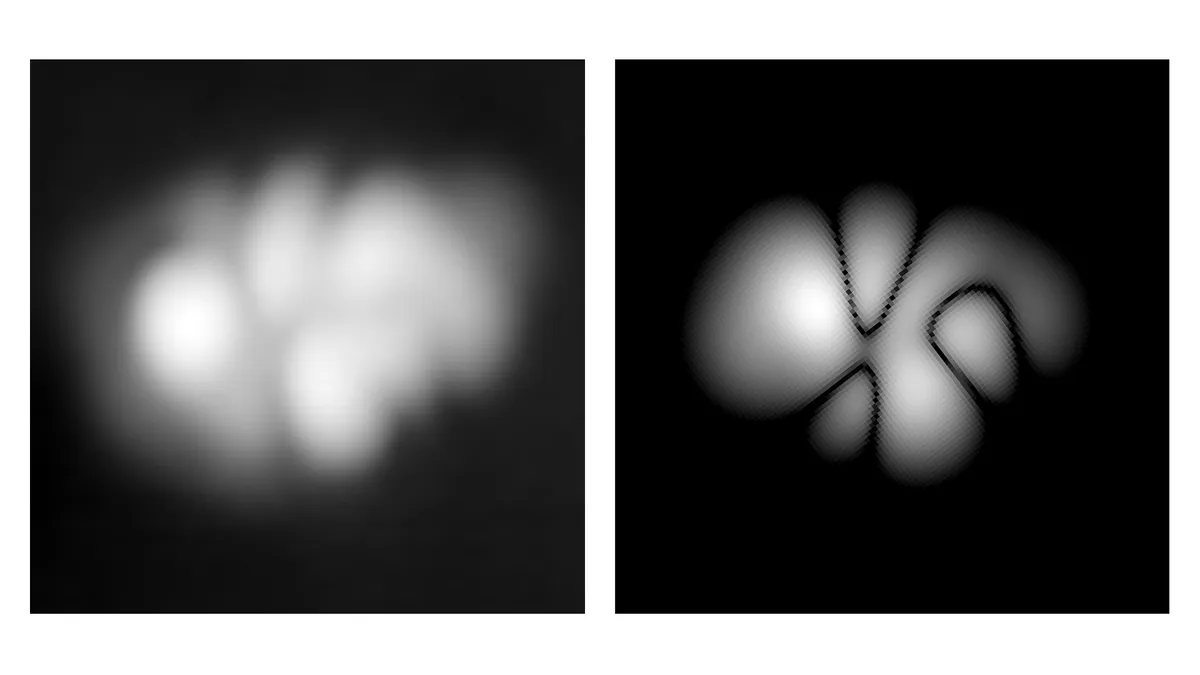
On the basis that only a quantum machine can truly understand high level quantum interactions, the team used a quantum computer to model the behavior of 32 outer electrons in the molecule. Possibly as significantly as the creation of the molecule itself, the simulations matched reality.
“First, we designed a molecule we thought could be created, then we built it, and then we validated it and its exotic properties with a quantum computer,” said IBM’s Dr Alessandro Curioni in a statement.
“This is a leap towards the dream laid out by renowned physicist Richard Feynman decades ago to build a computer that can best simulate quantum physics and a demonstration where, as he said, ‘There’s plenty of room at the bottom.’ The success of this research signals a step towards this vision, opening the door for new ways to explore our world and the matter within it.”
The work is published in the journal Science.



 1
1