Nature
 PUBLISHED


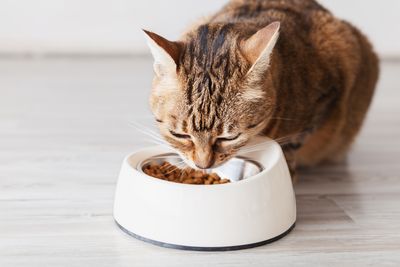


Cats can be dainty eaters, often just nibbling at the expensive food in their bowls before turning away in disinterest. If that sounds like a member of your household then scientists have some advice for you: stop feeding them the same stuff every day.
The rest of this article is behind a paywall. Please sign in or subscribe to access the full content.To learn more about cats’ aloofness with regard to food, the researchers recruited 12 pet felines and withheld food from them all for 16 hours. At the end of this fasting period, the cats were given a six-course meal, with each dish being presented to them for ten minutes.
When all six bowls contained the same pet food, the cats ate less and less with each serving, despite the fact that they were obviously hungry following their lengthy fast. However, when cats were presented with a variety of foods, they showed no such loss of interest and increased their overall consumption.
In one trial, the participants were given five identical dishes, followed by one unique course. Even when this final offering consisted of their least favorite pet food, the cats still showed a renewed interest in eating.
In another experiment, the study authors found that just the smell of a novel food was enough to trigger an increase in appetite, even if the actual meals presented to the cats remained the same. Conversely, persistent exposure to the smell of just one type of food caused the cats to eat less.
“The present study demonstrated that premature feeding cessation in domestic cats is closely associated with olfactory factors rather than physiological satiety alone,” write the researchers. “When the same food was presented repeatedly, the cats gradually reduced their intake, even after an overnight fast.”
The study authors therefore suggest that cats’ appetites are mediated by their sense of smell, whereby they quickly become “habituated” to familiar odors and therefore lose the desire to eat. Novel odors, however, trigger “dishabituation” and a renewed motivation to feed.
A similar phenomenon has been observed in humans and is known as “olfactory sensory-specific satiety”. Brain imaging studies have shown that this effect is linked to decreased activation of reward circuits in the orbitofrontal cortex, resulting in a loss of pleasure.
In cats, these neurological mechanisms are yet to be explored, although the study authors point out that this rapid sensitization to food may have deep evolutionary roots. Dogs, for example, tend to gorge themselves when food is available, like their pack-hunting ancestor the wolf. Domestic cats, on the other hand, descend from wildcats that hunt alone and therefore eat small prey multiple times a day.
This could explain why pet cats tend to consume light portions at regular intervals, rather than finishing what’s in their bowl in a single sitting. Now, it seems that olfactory habituation may provide the underlying mechanism driving this behavior.
According to the study authors, “these findings may also have practical implications for owned cats, suggesting that managing food-odor exposure could help support appetite during illness and limit overeating in cats prone to overweight/obesity.”
In other words, if you want your cat to eat more, you could try introducing novel foods. On the other hand, if you’re dealing with a fat cat, offering a monotonous diet may help to regulate their food intake.
The study is published in the journal Physiology & Behavior.