Humans
 PUBLISHED
 1
1


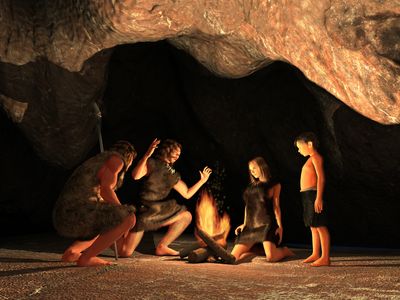


Religion, spirituality, and otherworldly beliefs are a mainstay of human culture, providing the foundation upon which virtually every civilization is built. Evidence for this devotion to sacred forces goes all the way back to the Paleolithic, when our species co-existed with Neanderthals, and a growing body of evidence suggests that this extinct lineage might have been capable of similar behaviors.
The rest of this article is behind a paywall. Please sign in or subscribe to access the full content.Neanderthal ritual
One of the biggest challenges facing archaeologists concerns the reconstruction of ancient practices, traditions, and experiences that leave no physical trace in the fossil record. Interpreting the symbolic thoughts and actions of prehistoric humans is therefore highly complicated, especially in relation to Neanderthals or other hominins that don’t belong to the same species as us.
However, material finds can shed some light on what our Pleistocene cousins might have been up to. For instance, in the 1990s, researchers discovered a peculiar structure deep within a Neanderthal cave in France, consisting of two rings of carefully arranged stalagmites. Exactly what this strange composition was used for remains unclear, although there is evidence that fires were regularly lit inside the speleothem circles.
Anthropologists are still trying to interpret this discovery – which dates back some 176,000 years – although one leading theory is that it was used as a ritual arena, thus hinting at possible symbolic, or even religious, beliefs. Having said that, it’s worth pointing out that the arrangement could have had a purely domestic function, and the jury is still very much out on what this find means for Neanderthal cognition and behavior.
Neanderthal funerals
Funerary traditions are closely linked to religious practices and belief in the afterlife, so it’s not insignificant that Neanderthals buried their dead. Interestingly, this behavior appears to have taken off around 120,000 years ago in the Levant, which coincides in both time and space with the earliest known Homo sapiens burials.
Some archaeologists therefore think that the two human lineages started interring skeletons as a means of marking territory as they began competing for resources in a key geographical region. However, these burials have also been interpreted as evidence for spiritual beliefs.
To make matters even more confusing, recent research has shown that these early Levantine burials were actually Neanderthal-Homo sapiens hybrids, produced as the two hominin lineages began interbreeding. This opens up the possibility that it was the exchange of both genes and culture between Neanderthals and modern humans that facilitated the rise of complex funerary traditions and all the associated cognitive processes.
The most famous Neanderthal graveyard, however, can be found in Shanidar Cave in Iraq, where seven individuals were buried around 60,000 to 80,000 years ago. One of these skeletons was found to be covered in pollen, sparking the idea of a “flower burial”, in which Neanderthals sent their departed off to the afterlife with an elaborate floral tribute.
Unfortunately, this idea has now been largely debunked, as it seems the pollen was introduced to the cave by solitary nesting bees.
A Neanderthal bear cult?
Another highly controversial theory concerns the worship of cave bears by Neanderthals. Originally put forward by Swiss archaeologist Emil Bächler in the early decades of the 20th century, the idea is based on the discovery of large numbers of bear bones inside an apparently unnatural cist at a site called Drachenloch – meaning “Dragon’s Cave”.
Years later, the hypothesis was debunked by analyses that found that the bones had in fact accumulated due to natural processes. Yet in the last few years, new evidence has come to light suggesting that Neanderthals did leave symbolic carvings on cave bear skulls in Poland, reigniting the possibility of a bear cult.
Elsewhere, at the Des-Cubierta cave in Spain, archaeologists have found dozens of horned skulls belonging to large mammals, including aurochs and steppe rhinoceroses. Gathered and stored by Neanderthals over multiple generations, the contents of this “skull cave” are extremely difficult to interpret, although it’s possible that the osseous collection represents some sort of spiritual or religious practice that was maintained for decades, centuries, or even longer.
Ultimately, however, it’s impossible to say for sure whether Neanderthals practiced a bear cult – or any other religion, for that matter.