Nature
 PUBLISHED


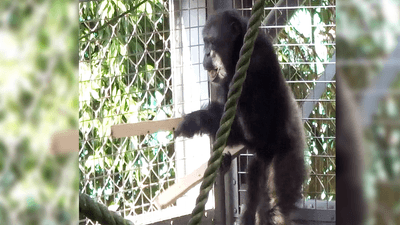


Scientists have observed chimpanzees drumming and noted patterns matching the structure of their vocalizations, creating an opportunity to explore the evolutionary origins of music. For the rest of us, the fact that one of the chimps was 23 when his talents drew scientists’ attention (in a species with half our lifespan) proves it’s never too late to follow your dreams of a musical career.
The rest of this article is behind a paywall. Please sign in or subscribe to access the full content.Chimpanzees are known for their drumming skills, which they use to communicate over long distances within forests. They’re also capable of complicated vocalizations, even if teaching them to talk by mouth, not hands, has proven a cruel dream. However, scientists at Kyoto University's Center for the Evolutionary Origins of Human Behavior (EHUB), were amazed by the sophistication with which a chimpanzee named Ayumu combines the two.
Drumming is clearly important to Ayumu, to the extent that he removed floorboards from a walkway to use as drumsticks, with his enclosure providing a diversity of surfaces to use them on. Researchers at the EHUB filmed 89 of his performances over two years and analyzed them.
"It was fascinating for me to see how the chimpanzee used tools to produce various sounds while also expressing a vocal display," said first author Yuko Hattori in a statement.
Intuitively, we would expect percussion to have been the first human instrument, but wood and animal skins seldom survive for thousands of years, so there is little archaeological support for this expectation. That has led those seeking to explore the origins of music to pay more attention to primate behavior.
To investigate the relationship between Ayumu’s vocal and percussion performances, Hattori and co-authors broke his activity down into elements and observed the transitions between. This revealed a constant tempo, particularly when using the wooden tools, with non-random transitions from drumming with the floorboards to dragging objects.
The capacity for metronome-like spacing of sounds has also been reported among western chimpanzees in the wild, so Ayumu probably didn’t get this from humans. On the other hand, eastern chimpanzees are known to prefer to alternate between long and short spaces between hits. However, wild drumming is usually done with hands or feet, even if chimpanzees show creativity in identifying resonant items to drum on.
The authors also noted that Ayumu’s facial expressions when drumming were positive, unlike those seen during vocal displays. Their interpretation is that Ayumu, and therefore presumably other chimpanzees, can express their happiness through instruments. The next step in their research is to study how Ayumu’s fellow chimpanzees respond to his musical prowess. Does being a rock star get a chimp laid? Or is the response more like the one to a garage drummer who unleashes a virtuoso but deafening solo at 2 am?
Although Ayumu is the only chimpanzee whose advanced drumming capacities have been described in peer-reviewed literature, that status may not last long. A preprint by a different team describes similar behavior by another captive chimpanzee, Toon, featuring many of the same observations, such as the “play face” both chimpanzees put on when drumming up a storm. However, Toon’s use of available sticks and even a cardboard box to strike surfaces with arguably doesn’t match Ayumu’s enthusiasm and planning in pulling up floorboards.
Every band member who has, after some screw-up, threatened to replace their drummer with an ape can now feel vindicated. They might need to move soon, however. Who knows if record companies are already competing for Ayumu’s signature?
The study is published in Annals of the New York Academy of Sciences.