Nature
 PUBLISHED
 1
1


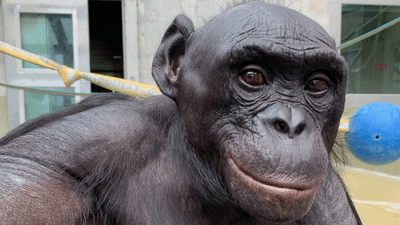


Imagination is one of our greatest superpowers, but how far back does it go? Scientists from Johns Hopkins University recently investigated one aspect of imagination in bonobos: the ability to play pretend.
The rest of this article is behind a paywall. Please sign in or subscribe to access the full content.Their key participant was a male bonobo named Kanzi who lived at the Ape Initiative in Iowa. Imagination is, of course, a rather abstract concept, so to explore if Kanzi could play along they had to get creative.
They had to have a tea party.
The original methods used to study children only needed minor modifications to be applied to Kanzi.
Dr Amalia P. M. Bastos
“The tea party pretend scenario is the sort of context that was first used to show pretence in children, when this phenomenon was first studied by psychologists in the late 1900’s,” said study author Dr Amalia P. M. Bastos to IFLScience. “It seemed well-suited to Kanzi, too, as he has observed and interacted with cup-like and jug-like options throughout his life as a very enculturated ape, so the original methods used to study children only needed minor modifications to be applied to Kanzi.”
The experiments unfolded in three stages (that you can see in the video below) to explore if Kanzi would engage with pretend juice, if he understood the difference between real and pretend juice, and if he would engage with pretend grapes. The results showed that Kanzi could distinguish between real and imagined, as when real offerings were on the table he opted for them consistently. In the imaginary scenarios, Kanzi wasn’t perfect, but he was consistently correct in choosing the pretend juice or grape containers.
The results suggest Kanzi, a highly encultured ape, had the cognitive capacity for at least one aspect of imagination: being able to conceive of things that aren’t really there. The researchers say it’s just the beginning of continued research, but it could indicate that the ability dates back to around 6 to 9 million years ago when we last shared a common evolutionary ancestor with amazing apes like Kanzi.
Our next steps may now focus on modifying our study methodologies to try and investigate this sort of phenomenon and ability in less enculturated apes.
Dr Amalia P. M. Bastos
Unfortunately, Kanzi won’t be attending anymore tea parties. The much-loved bonobo (who understood human language) passed in early 2025 aged 44 (bonobos have a lifespan of around 20 to 40 in the wild, and around 40 in captivity).
“If Kanzi were still with us, we would have loved to attempt some studies where he might engage in pretence himself, rather than observing the researcher perform pretend actions alone,” said Bastos.
“Given that this is no longer possible, our next steps may now focus on modifying our study methodologies to try and investigate this sort of phenomenon and ability in less enculturated apes. We are beginning to think of some ideas on how we might be able to do so in the future, for example through eye-tracking technology.”
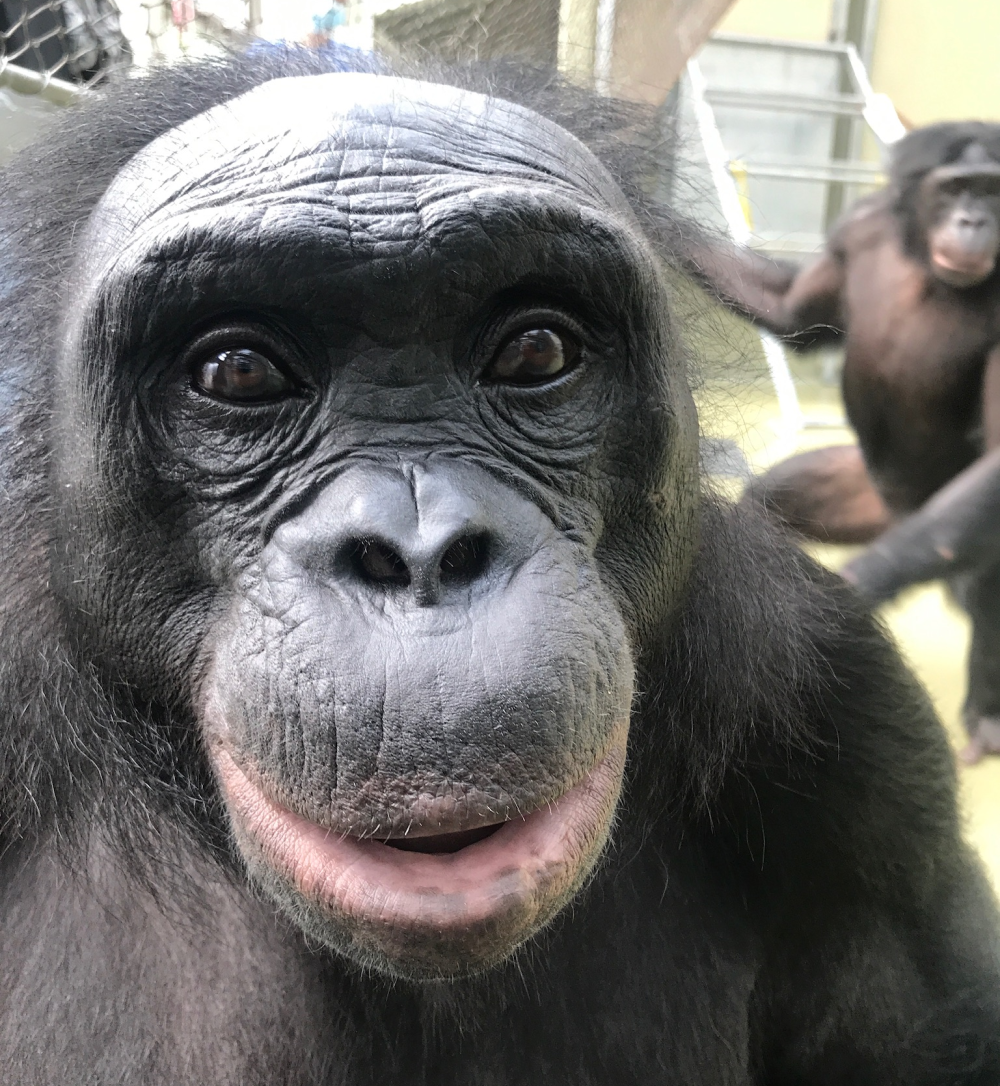
Pretending is thought to be a valuable tool for human children in enabling them to try out scenarios without the risk of real-world consequences. It’s easy to see how this would benefit wild animals, tool, but it goes beyond pretend.
Pretence is a small part of the puzzle in the realm of secondary representations, adding to a growing body of knowledge that nonhuman animals live richer inner lives than some might think.
Dr Amalia P. M. Bastos
Imagination also touches on secondary representation, which is the ability to form ideas about situations that aren’t in the present. That includes thinking about the past and the future and trying to read other individuals in social interactions.
“Secondary representations therefore provide an immense evolutionary benefit, allowing the animal to differentiate between what they are currently perceiving in the world around them, and how things could be, say in a different time, or according to another’s perspective,” said Bastos.
“Pretence is a small part of the puzzle in the realm of secondary representations, adding to a growing body of knowledge that nonhuman animals live richer inner lives than some might think.”
The study is published in the journal Science.