Health and Medicine
 PUBLISHED


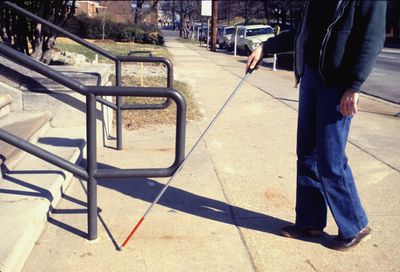


Some blind people can use the returning echoes from clicking their tongues to "see" with echolocation, and now researchers have explored how this process builds up a picture of the outside world in their brains.
The rest of this article is behind a paywall. Please sign in or subscribe to access the full content.To those who haven't heard about this before, it sounds almost too fantastical to be true, but human beings really can use echolocation, and it's actually quite a well-documented phenomenon. Previous studies have shown that blind echolocators can walk just as fast as sighted people and take similar paths to avoid obstacles.
In new research, scientists at the Smith-Kettlewell Eye Research Institute in California tested four blind people who were comfortable using echolocation and found they could identify the locations of objects better than 21 sighted people attempting to perform the same feat (also using sound, not their eyes).
What's more, the accuracy of the best echolocators improved with each click, and measurements of their brain activity showed neural activity strengthened in concert with this improvement, giving us our first insight into how the brain builds a picture of the space around a person using echolocation.
According to the researchers, this work reveals how the brain uses repeated sound information to create representations of the environment in the absence of vision. Study author Haydée García Lázaro said in a statement: “Basically, we found that, in some experts, there appears to be a summation, or accumulation, of information in the brain that builds up across clicks about object location.”
To ensure a fair test, García Lázaro and colleagues came up with a setup that used a "virtual" object. This means they synthesized the kind of mouth click a skilled echolocator would produce, then modeled how the waveform would change if it were reflecting off an object placed at various positions 1 meter (3 feet) away from the observer.
Participants then sat in front of a display and were played a sequence of two or more clicks representing the position of a virtual object at an angle somewhere between 5 degrees and 25 degrees, after which they used a keyboard to indicate where they thought the object was located. This was repeated tens of times for different virtual objects, and the participants' brain activity was measured throughout by an electroencephalography (EEG) cap.
For expert echolocators, accuracy increased both with the number of clicks they heard and the angle of the object's location, indicating that objects at a wider angle were relatively easier to locate, and each new click refined their understanding of where the object was placed. Those who were most accurate showed a sharp increase in neural activity even after the first click, and this strengthened as more clicks were heard, until reaching a plateau.
"From a signal detection perspective, multiple echoes increase the effective signal-to-noise ratio available to the perceptual system by providing convergent information that boosts perceptual certainty," wrote the researchers in their paper.
The sighted participants performed, as a group, about as good as chance, while echolocators who had gone blind early in life performed with about 70 percent accuracy. One participant who had gone blind later in life performed less well, but still better than chance.
In their paper, the researchers acknowledged that, in other tests, sighted individuals have been known to perform better, so there might be some aspect of their experimental setup, such as the constant spatial orientation between the object and the participant, that explains some of the performance differences.
They also suggest that future experiments could use more spatially accurate EEG measurements to determine exactly which neural circuits are activating, and they are excited that the work could help determine what makes blind people adept at echolocation and aid in training people to engage their echolocation ability.
Speaking to IFLScience, García Lázaro said understanding echolocation could "help guide the development of applications and training programs by identifying [...], for example, whether blind individuals develop finer auditory filters for spatial cues or can segregate echoes more quickly and efficiently [than sighted people]."
The study is published in the journal eNeuro.
This article was amended to include a quote from García Lázaro about future applications of the research.


 1
1