Nature
 PUBLISHED


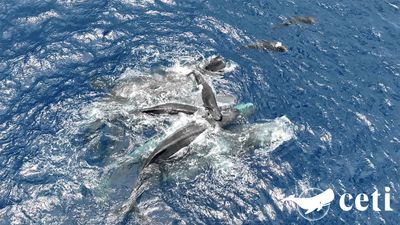


Witnessing the birth of any animal is a special moment, but wild births can be hard to come by, especially when the creature you are hoping to see lives in the ocean. However, thanks to some spectacular drone footage, researchers have now captured the moments surrounding a sperm whale birth in incredible detail, revealing more about the complex social lives of these marine mammals.
The rest of this article is behind a paywall. Please sign in or subscribe to access the full content.On July 8, 2023, aerial drone footage recorded the birth of a sperm whale (Physeter macrocephalus) calf in the waters surrounding Dominica in the eastern Caribbean. These sperm whales have been extensively studied for over two decades, allowing researchers insights into their relationships and relatedness with each other.
What the drone captured was extraordinary. On the day of the birth, the team saw a group of sperm whales gathering, consisting of 11 whales – eight adults and three calves – that were all named and known to the researchers. However, the whales in the group also came from two different matrilines that are not normally seen together. The group containing the pregnant mother, called Rounder, was joined by another unrelated group of sperm whales that all assisted the mother during the labor and the moments after the calf was born.
Birth is such a vulnerable moment, and it is often in vulnerable moments that the true structure of social bonds becomes most visible.
Alaa Maalouf
Sperm whale calves are born negatively buoyant, so they must be helped to the surface to breathe for the first period of their lives. Both related and unrelated whales from each of the groups came together to assist the newborn, all captured on the drone footage, marking an extremely detailed and rare observation of cooperative care in these cetaceans. In fact, this is the first quantitative evidence of cooperative birth assistance outside of primates.
At 11.12 am, the delivery of a whale calf began and can be identified on the footage as flukes emerging from the female. The other adult female whales moved into positions surrounding the birthing female during the 34-minute birthing process. All the whales then took turns physically lifting the newborn to the surface for around an hour after the birth. Only two to three hours after the delivery did the group disperse into the more usually seen foraging groups.
Over the last 60 years, just one other sperm whale birth has been scientifically documented, and only four observations just after birth. These have come from anecdotes or whaling-related activities, which means this observation and footage are the first real opportunity that gave researchers insights into the cooperation of the whales.
“Using machine learning to track whales in the aerial videos allowed us to quantify how all of the whales in the unit interacted with each other and with the newborn. We found that the two matrilines consistently mixed together and took turns supporting the newborn, which was surprising since over the years these two groups have not usually been seen interacting during ordinary foraging,” Joseph DelPreto, Project CETI’s Machine Learning Team Member, told IFLScience.
The team saw that there was a core group that maintained near constant physical contact with the newborn after birth, including the mother, her half-sister, a juvenile female that was not related, and an older female whale that was related to the newborn through the maternal line. Every whale acted as the primary supporter of the newborn at some point during the event, regardless of whether they were part of the core group.
“This was one of the most striking findings, because birth is such a vulnerable moment, and it is often in vulnerable moments that the true structure of social bonds becomes most visible. The fact that non-kin also helped support the calf during this period suggests that sperm whale society may be built on something more complex and deeper than close family ties alone,” Alaa Maalouf, Project CETI’s Robotics and Machine Learning Team Member, told IFLScience.
This birth event also attracted the attention of two other marine mammal species: short-finned pilot whales (Globicephala macrorhynchus) and Fraser’s dolphins (Lagenodelphis hosei). When the group encountered the short-finned pilot whales, the unit was traveling very close together, with the newborn being physically moved onto the backs of the whales to reach the surface. The presence of the pilot whales slowed the group's movements.
Audio was also recorded during the birth that showed clear differences during each stage of the birth through a variety of clicks and codas. Some codas were able to be assigned to vowel-like sounds such as a and i. These vocalizations could have been intercepted by the other species, leading to the arrival of the dolphins and pilot whales.
At least one adult female was always positioned between the newborn and the pilot whales during the approximate two hours the interactions lasted. There was even an incident where one of the pilot whales rammed the nose of the adult females closest to the newborn. Sperm whales would also open their mouths and jerk their heads towards the pilot whales.
The multi-species interactions could certainly have influenced how the sperm whales behaved and how they coordinated their support of the newborn.
Joseph DelPreto
There was not thought to be any direct physical contact at any point between the sperm whales and the dolphins, though there were several close approaches.
“The multi-species interactions could certainly have influenced how the sperm whales behaved and how they coordinated their support of the newborn. For example, the lifting behaviors that we saw are consistent with the newborn being negatively buoyant and unable to dive deeply, and this need to stay at the surface with the newborn could have caused the sperm whales to respond differently to the presence of the pilot whales and Fraser’s dolphins than they normally would,” said DelPreto.
After the birth, the group was not seen again for over a year until an observation on July 25, 2024, when the now one-year-old newborn was seen with two other young whales from the unit. This is a positive sign, as newborns that survive the first year have a higher chance of surviving until adulthood.
One theory to explain the lifting behavior is that it might be a very ancient practice dating back 36 million years, further than the most recent common ancestor between toothed and baleen whales. The cooperative care of the newborn to lift it to the surface has also been seen in toothed whales, suggesting a shared evolutionary origin.
“This study is exciting not only because of what it shows, but also because of what it opens up. One of the most important points is that the scale of cooperation we observed not only points to the social sophistication of sperm whales, but may also provide clues about their cognitive abilities,” said Maalouf.
“It raises open questions about how such behavior is communicated and coordinated, and about what cognitive capacities may support it. In that sense, the study opens a broader window into the social and cognitive complexity of sperm whales.”
The studies are published in Science and Scientific Reports.
Correction: An earlier version of this article incorrectly stated Joseph DelPreto's title as Project CETI's Robotics and Machine Learning Team Member. It has been corrected to Project CETI's Machine Learning Team Member.