Nature
 PUBLISHED





There are plenty of long-lived organisms out there. Lonesome George the giant tortoise made it past 100; Maria Branyas Morera reached 117. Greenland sharks can live at least twice that, and potentially as much as four times as long; Ming the clam lived for half a millennium before it was unceremoniously frozen to death by a team of researchers in 2006.
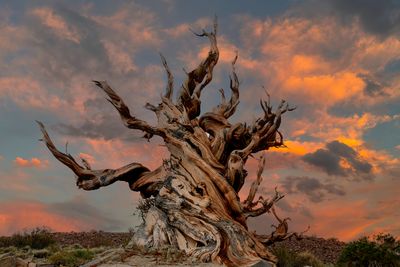
The rest of this article is behind a paywall. Please sign in or subscribe to access the full content.But none of these individuals holds a (birthday) candle to the longest-living individual on Earth: the Great Basin bristlecone pine. Both aptly and bawdily named, Pinus longaeva can live for over 5,000 years and counting – and now, thanks to research out of the University of California, Davis, we’re starting to understand how they do it.
“People ask me those kinds of things: ‘David, tell me which is the longevity gene, and I will clone it, patent it and sell it’,” said UC Davis professor emeritus of Plant Sciences David Neale in a statement this week. “Of course, it’s massively complex. But there could be some fundamental discovery of the genetic basis of longevity in this one organism that could be applied to other organisms.”
And so, with a permit from the USDA Forest Service, Neale and his team set out on a field trip to California’s White Mountains. They collected tissue samples from the needles and seeds of a bristlecone pine, which would then be taken to Johns Hopkins for genetic sequencing.
It was a big ask. “Assembling a 24 billion base pair genome that is eight times the size of the human genome is a significant technical challenge,” said Steven Salzberg, a professor of biomedical engineering at Johns Hopkins University and co-author of the study. But upon closer inspection, things were simpler than they seemed: “Despite its great size […] the genome of bristlecone pine contains only slightly more genes than the human genome,” Saltzberg explained. “The rest of the genome is filled with millions of repetitive 'junk DNA' sequences, which appear to do no harm to the organism, since it has carried these repeats through millions of years of evolutionary history.”
The result, huge though it was, showed some clear advantages for any tree trying to live its longest life. There were genes for wound healing and DNA repair; genes promoting leaf growth and expansion; genes for disease resistance – more of them, and stronger than in other organisms. The tree’s telomeres – the protective “caps” on the ends of chromosomes that stop their charge from fraying or breaking down, like the aglets on the ends of shoelaces – were larger than average for conifers, hinting at a longer cell life and slower aging.
There are some environmental factors that might help the bristlecone pine live so long – it tends to live in rather extreme regions, for example, which cuts down on the number of competitors or predators in the area. But its extreme longevity and ecological success make its genome a tantalizing prospect for both ecologists and senescence researchers: “It’s like having a parts list,” Neale explained.
“Sequencing one tree does not give us clear insights as to the genetic basis of longevity,” he cautioned. “It could be the bristlecone pine tree is fundamentally unique and nothing lives to be like it.”
“But having a reference genome sequence as it applies to human health and everything else is a necessary reagent in modern biology,” he added. “There is now a resource from which modern genetic discovery can begin based on this resource.”
The study is published in the journal G3: Genes|Genomes|Genetics.