Space and Physics
 PUBLISHED


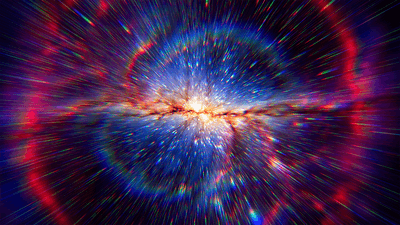


A team of physicists have proposed a new idea for uniting quantum mechanics and gravity, which they believe could explain the earliest moments of the universe. While interesting, and potentially even testable in the near future, the hypothesis comes with a ghost.
The rest of this article is behind a paywall. Please sign in or subscribe to access the full content.Quantum mechanics is our best understanding of the universe at atomic and subatomic scales. With it, we have revolutionized our understanding of physics on teeny tiny scales, and all the quantum weirdness that involves.
General relativity, meanwhile, is our best understanding of gravity. According to the theory, which has so far passed every test we have thrown at it, gravity is not a force but the result of the curvature of spacetime around matter.
But the two do not play well together, and one of the greatest challenges faced in physics today is to unite the two into a single theory describing the very large and the very small.
There have been plenty of proposals on this front, from loop quantum gravity to string theory, though all come with their quirks and oddities, or are untestable with any experiment we can currently dream of conducting.
A particular problem, which the new paper aimed to tackle, is that general relativity stops working at the extremely high energies predicted at the Big Bang. That's not to say gravity gets switched off, but the math breaks down whilst trying to describe the universe at these high energies.
The team used an idea known as quadratic gravity, first proposed by British-American physicist Kellogg Stelle in 1977. This idea adds quadratic terms to the curvatures in the fundamental action. This makes the theory renormalizable, or for non-physicists, it means that you can deal with the infinities that arise at high energies by making spacetime act more like the electromagnetic field.
While most current ideas about the Big Bang use general relativity and add in quantum components by hand, the team believes that using quadratic gravity, the early expansion of the universe can naturally emerge.
“This work shows that the universe’s explosive early growth can come directly from a deeper theory of gravity itself,” Dr Niayesh Afshordi, professor of physics and astronomy at the University of Waterloo and Perimeter Institute (PI) and lead author on the paper, said in a statement. “Instead of adding new pieces to Einstein’s theory, we found that the rapid expansion emerges naturally once gravity is treated in a way that remains consistent at extremely high energies.”
Though a new idea is great, we have a lot of them. What we really need is something we can test, and on this front, the team was surprised to find some very specific signatures to look for in the form of primordial gravitational waves, which should be detectable in upcoming surveys if this hypothesis is correct.
"Even though this model deals with incredibly high energies, it leads to clear predictions that today’s experiments can actually look for,” Afshordi added. “That direct link between quantum gravity and real data is rare and exciting."
While that is exciting, the idea comes with its own inherited problems in the form of "ghosts". Quadratic gravity predicts a few new particles, including a massless graviton and an additional scalar boson, and an unholy and massive monster spin-2 ghost particle, with negative energy and even negative probabilities to deal with, that remain problematic even 50 years after the idea was first proposed. The team does not address this ghost particle too much in this research, acknowledging that it needs more work.
"We should highlight that what would make this scenario unique is that gravity does become strongly coupled at some scale, which is also used to confine ghost degrees of freedom," the team writes in their paper. "In contrast, in Starobinsky inflation, gravity remains weakly coupled, and thus the containment of ghosts and Ostrogradsky instabilities would require a more creative solution."
In short, the new idea shows promise in explaining a lot of what we see in the early universe, and is an interesting avenue of investigation. But it comes with a few ghosts, with negative energy and negative probabilities to contend with, and that could be pretty complicated to get our heads around indeed.
The study is published in Physical Review Letters.

 1
1