Nature
 PUBLISHED
 1
1


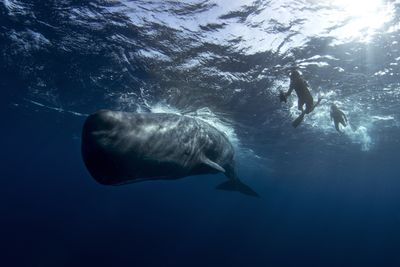


Who would have guessed? Sperm whales really did get their name because of semen and a slightly embarrassing misunderstanding.
The rest of this article is behind a paywall. Please sign in or subscribe to access the full content.The sperm whale’s name comes from "spermaceti", a waxy substance that’s produced by a large organ in the giant head. The organ may contain up to 1,900 liters of spermaceti, which comes from the Medieval Latin sperma ceti, meaning "whale sperm" and was coined by 17th century whalers.
This stuff has always been a bit of a mystery. One theory suggests that the oily material aids in transmitting and focusing the powerful clicking sounds that sperm whales use for echolocation, while another proposes that it helps the whale regulate its buoyancy as it plunges to the ocean's depths. Back in the day, people had even stranger ideas about its function.
Chemically, spermaceti is made mostly of cetyl palmitate and fatty acids. It remains liquid inside the warm body of a whale but quickly solidifies and crystallizes when exposed to cooler air, a property that made it very appealing to humans.
People used to be truly obsessed with it. Thanks to its high melting point, clean burn, and lack of odor, the substance was used for a variety of applications, from candles and cosmetics to ointments and industrial lubricants. Demand for the substance decimated sperm whale populations throughout the 19th and early 20th centuries, as thousands upon thousands were hunted and had their massive head cracked open to extract the lucrative semi-liquid inside.
Why are they called sperm whales?
Despite its name, spermaceti has nothing to do with squiggly male reproductive cells. Off-white in color and gloopy in texture, 17th-century whalers mistook the substance for the whale’s semen (let's not ask why it was on their faces). This is why they named the species the sperm whale, and, for whatever reason, the name stuck.
Scientists refer to sperm whales with the more sensible species name Physeter macrocephalus. Reaching up to 18.5 meters (60 feet), they are the largest toothed predator on Earth, known for their deep-sea tussles with giant squids and other elusive prey.
There’s evidence that their population numbers are starting to recover in the post-whaling era, although progress is slow and uneven. Decades after whaling was outlawed globally, sperm whales are considered to be “vulnerable” to extinction under the IUCN Red List.
They face a bunch of modern threats, from climate change to disturbance from shipping, but much of their ongoing plight can be traced directly back to humanity’s centuries-long hunger for spermaceti.