Nature
 PUBLISHED


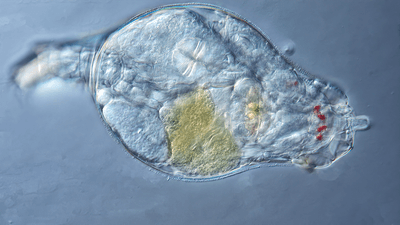


Rotifers – microscopic aquatic animals that spend their lives in fresh water, or on thin layers of liquid which surround soil – are incredibly hardy creatures, capable of surviving in low oxygen environments, and through periods of starvation, and freezing. How hardy are they exactly? Well, at least one little rotifer has lived an incredibly odd life, lying frozen in the permafrost of Siberia, before thawing out 24,000 years later and continuing like nothing had happened.
The rest of this article is behind a paywall. Please sign in or subscribe to access the full content.In 2021, scientists from the Soil Cryology Laboratory at the Institute of Physicochemical and Biological Problems in Soil Science in Pushchino, Russia, were doing what they do on a regular basis; using drills to take samples of the Siberian permafrost, before searching for microorganisms within them.
At the time, it was known that rotifers could survive up to 10 years whilst frozen in temperatures reaching as low as -20 °C (-4 °F). That figure was revised upwards somewhat, thanks to one particular sample, taken from the Alazeya River in northeastern Siberia. It contained a bdelloid rotifer that appeared to have been frozen in place thousands of years in our past.
"The core contained ice-rich loam from the Late Pleistocene Yedoma formation (also called the Ice Complex)," the team explained in a study published in Current Biology. "The shape, good development and wide distribution of ice wedges, and occasional finding of well-preserved mammal mummies support syncryogenetic formation of the Ice Complex, i.e. that layers of sediments were frozen relatively quickly after their formation and have never melted."
Dating the sample using accelerator mass spectrometry yielded an age of around 23,960–24,485 years old. And yet, when the team thawed out samples in a culture, they found rotifers living out their lives and even enjoying a little obligate parthenogenesis, the method by which they reproduce. They concluded that a rotifer had become frozen in the soil, before resuming its life 24,000 years later.
"Our report is the hardest proof as of today that multicellular animals could withstand tens of thousands of years in cryptobiosis, the state of almost completely arrested metabolism," study author Stas Malavin of the Soil Cryology Laboratory said in a statement at the time.
While impressive, the rotifer is not without competition for the longest period in a dormant state, with the same team finding that two roundworms (nematode) species were able to survive for a period of about 46,000 years in a state of cryptobiosis. Though also just neat to know how hardy these animals are, the team hopes to learn how these animals survive in such extreme environments, perhaps offering clues as to how human cells could be better preserved.
"The takeaway is that a multicellular organism can be frozen and stored as such for thousands of years and then return back to life – a dream of many fiction writers," Malavin added. "Of course, the more complex the organism, the trickier it is to preserve it alive frozen and, for mammals, it's not currently possible. Yet, moving from a single-celled organism to an organism with a gut and brain, though microscopic, is a big step forward."
An earlier version of this article was published in June 2021.