Humans
 PUBLISHED


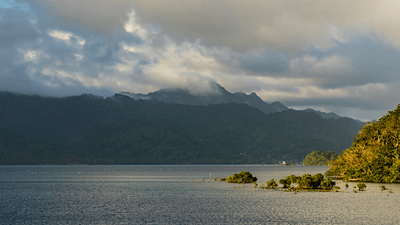


Researchers have concluded that a large shell-dense island off the coast of Culasawani, in the northern Vanua Levu Island in Fiji, is likely the not the result of a tsunami as previously assumed. Instead, it likely sprung up around 1,200 years ago due to human activity in the area.
The rest of this article is behind a paywall. Please sign in or subscribe to access the full content.In 2017, researchers conducting a geoarchaeological survey of the coast of Vanua Levu stumbled across a small 3,000-square-meter (32,291-square-foot), low-lying island surrounded by mangroves. Looking closer at it, this raised landmass was found to be almost entirely made of the remains of edible shellfish, mixed with a sandy clay.
"These were not merely on the surface," the team explains in their paper. "In many places, burrowing crabs (Scylla serrata) had brought subsurface materials from depths of 30–50 cm [12-20 inches] to the ground surface, showing that shellfish remains also formed the bulk of these."
Two teams have since been to investigate the island, which sits about 60 centimeters (24 inches) above the average high tide, at the island's highest points. So, what is going on with it, and how did this island of shellfish come to be?
There were a few hypotheses worth investigating. One, initially favored, was that the island was caused by wave mechanics, with the ocean depositing the shellfish where they now peek above the water.
"The narrow concentration of ages around 1190 cal BP (760 CE) ± 99 may indicate that this deposit was created when a large (tsunami?) wave once washed across the area with great force," the team explains. "Perhaps this wave impacted a shell bed, even an ancient midden, on the sea floor west of the island and broke it up, carrying remnants far inland."
However, this was at odds with the types of shells found in the area. With nearly all of them being of the edible variety, the team believes a more likely explanation is that they were deposited by a group of early settlers. The team suggests that the early settlers could have processed huge numbers of the shellfish there, discarding the shells over the course of a few hundred years, consistent with carbon dating.
When an island is made of discarded shells like this, or other waste such as animal bones, it is known as a midden.
Midden islands have been discovered around low-latitude Pacific islands, where shellfish make up a large percentage of ancient peoples' diets. Sometimes, they even built up an island beneath themselves.
"In those islands in the western Pacific around which sea level fell during the period of their (early) human settlement, the long-term consumption of shellfish and the discarding of their inedible remains sometimes led to the emergence of shell-dense land suitable for human habitation," the team explains.
"In several early-period coastal sites in this region, the earliest settlements were on stilt platforms built out across shallow coastal/reef flats underwater at high tide. As midden built up on the sea floor and sea level fell, so stilt-platform settlements were replaced by on-land settlements, plausibly as a result of in-situ land emergence."
The team favors the explanation of the island being a human deposit, with pottery fragments found at the site, though it is still not conclusive. For instance, tools have not yet been found in the area, though it could be that they did not use stone tools for the job.
The team did not completely rule out the island being deposited naturally, and plan to investigate further afield for signs of a tsunami. This includes searching nearby for similar deposits, as well as surveying locals to see if they have tales of ancient large waves in the area, with previous research showing that memories of extreme events can be passed down in oral histories for over 2,000 years.
If further work confirms that the island is a midden, it would be the first to have been found in the South Pacific west of Papua New Guinea, an island made of ancient seafood packaging.
The study is published in the journal Geoarchaeology.