Nature
 PUBLISHED
 1
1





Researchers investigating the origin of complex life on Earth appear to have solved a longstanding mystery at the heart of how animals, plants, and fungi evolved.
The rest of this article is behind a paywall. Please sign in or subscribe to access the full content.To understand the conundrum, you must first know that there are two major types of cells – eukaryotes, which are packed with internal structures like a nucleus and mitochondria, and prokaryotes, which get by without any of that stuff.
All of what we call complex life, which is basically anything you can see with your naked eye – and a lot more besides – is made from eukaryotic cells. Prokaryotes, on the other hand, include bacteria and another group of single-celled organisms called archaea.
The most widely accepted theory for how we got complex life is that an archaeal cell, specifically a type called an Asgard archaeon, swallowed a bacterium. Rather than being digested, however, that bacterium went on living inside the archaeon and eventually became what we recognize as mitochondria today.
This theory is convincing for a number of reasons, including that the DNA inside mitochondria is similar to that of modern alphaproteobacteria, and that the cell membranes of eukaryotes are more similar to those of archaea than they are to bacterial cell membranes.
There is, however, one major sticking point: research on Asgard archaea, which were only discovered in 2015 in sediment from a hydrothermal vent called Loki’s Castle, suggests they prefer oxygen-poor environments. The bacteria they are supposed to have swallowed, however, are expected to have lived where oxygen was plentiful – after all, the function of mitochondria today is to use oxygen to turn the food we eat into energy in a process called respiration.
This massive sequencing effort nearly doubled the number of genomes from the closest known archaeal relatives of the host that gave rise to eukaryotes.
Kathryn Appler
According to the new study from the University of Texas at Austin, though, this problem turns out to be a non-issue, because there are plenty of Asgards around today that actually use, or at least tolerate, oxygen.
“One of the big questions in biology and evolution of life on the planet is what events led to the formation of complex life (plants and animals),” Brett Baker, study lead and an associate professor of marine science and integrative biology, told IFLScience. “This study provides new clues about the lifestyle of our microbial ancestors, and we think they could breathe oxygen like us!”
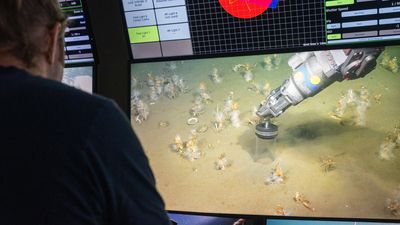
Compiling data from several marine expeditions, the team wrangled about 15 terabytes of environmental DNA, from which they obtained hundreds of new Asgard genomes.
Then, using a machine-learning tool called AlphaFold, which lets you take genetic data and see what kinds of proteins it might produce, the researchers were able to show that genes in a type of Asgard archaea called Heimdallarchaea make proteins that look like components in the electron transport chain, a structure that is involved in oxygen metabolism.
"This massive sequencing effort nearly doubled the number of genomes from the closest known archaeal relatives of the host that gave rise to eukaryotes, providing a more comprehensive view of their ecology and metabolism," first author Kathryn Appler, now a postdoctoral researcher at the Institut Pasteur, told IFLScience.
What’s more, some of the samples they analyzed came from shallow water sediments where aerobic alphaproteobacteria still live today, suggesting that interactions similar to that thought to have originated eukaryotic life are still observable today.
“Most Asgards alive today have been found in environments without oxygen,” explained Baker in a statement. “But it turns out that the ones most closely related to eukaryotes live in places with oxygen, such as shallow coastal sediments and floating in the water column, and they have a lot of metabolic pathways that use oxygen. That suggests that our eukaryotic ancestor likely had these processes, too.”
The study is published in Nature.