Space and Physics
 PUBLISHED



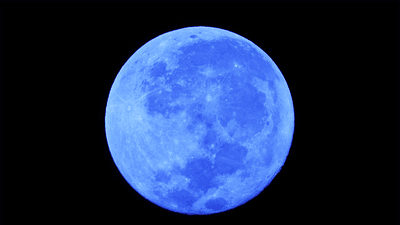


We are used to the Moon being bright white, silvery, yellow, or tinged with orange or red. But in rare circumstances the Moon can appear blue or even purple. That was the case in 1883, when witnesses reported the Moon had turned blue, and the Sun had turned a "bright blue" and a "splendid green".
The rest of this article is behind a paywall. Please sign in or subscribe to access the full content.The surface of the Moon itself, of course, did not change color. Throughout 1883, as through all of its history, it remained mostly grey, with a few lighter and dark patches to keep it interesting. So, what happened?
The Moon's color, from our vantage point here on Earth, is affected by our atmosphere. On clear and unpolluted nights, when the Sun is high in the sky, it will appear silvery-white, as the light makes its way through the atmosphere relatively unaffected to enter your gawping eyeballs.
But light in the blue spectrum is more easily scattered by the atmosphere than light towards the red end of the spectrum, a result of its shorter wavelength. If the light reflected off the Moon travels through enough atmosphere, this scattering builds up to the point it has a noticeable effect on the Moon's appearance, though not usually in the way observed in 1883.
"There's one notable way in which the Moon's appearance is actually different when it's low in the sky. It tends to have a more yellow or orange hue, compared to when it's high overhead," NASA explains. "This happens because the Moon's light travels a longer distance through the atmosphere. As it travels a longer path, more of the shorter, bluer wavelengths of light are scattered away, leaving more of the longer, redder wavelengths. (Dust or pollution can also deepen the reddish color.)."
But in 1883, the Moon and the Sun turned blue, not red. In order for this to happen, more blue light must have been making it to people's eyeballs than red – the opposite of the usual effect of scattering. The culprit was pretty obvious – Krakatoa had erupted spectacularly earlier that year – but the precise mechanism was not.
"The suppression of red light in transmitted spectra may in principle be caused by wavelength selective absorption or scattering processes, where absorption could be due to gaseous constituents or aerosols," a study on the topic explains, essentially saying that the presence of gases and other materials in the atmosphere could explain the strange scattering.
Previously it had been suggested that blue Sun and Moon of 1883 were caused by water vapor in the atmosphere, but more recent modeling indicates this is highly unlikely. The evidence now tends to favor the explanation that sulfur dioxide, as well as other particles released by the volcano, were the cause.
"Green volcanic twilights can be explained by anomalous scattering occurring for sufficiently large particles (i.e. radii of about 500 to 700 nm) and a preferably narrow particle size distribution," another paper on the topic explains.
As the particles were slightly wider than the wavelength of red light, this end of the spectrum had a tougher time than blue light making its way through the atmosphere, resulting in a blue-green Moon, Sun, sunrise and sunset. The same effect can occur during forest fires, as well as subsequent volcanic eruptions, where similar-sized particles are released.
To make matters confusing for astronomers and fans of the phrase "once in a blue Moon", we also use the term "blue Moon" to refer to a much more frequent and mundane occurrence. Since the Moon's orbit, disrespectfully, doesn't quite line up with our 12 calendar months, once every roughly two and a half years we have 13 full Moons in a year, rather than the usual 12. This extra Moon is termed a blue Moon, and – contrary to the intended use of the phrase – occurs quite frequently and predictably.

 1
1