Nature
 PUBLISHED




Long before humans developed their love of cats, Paleolithic hunter-gatherers were very much dog people. According to new research, pre-agricultural populations across Eurasia routinely treated canines as if they were humans, often sharing their food with them and even burying them like they would a family member.
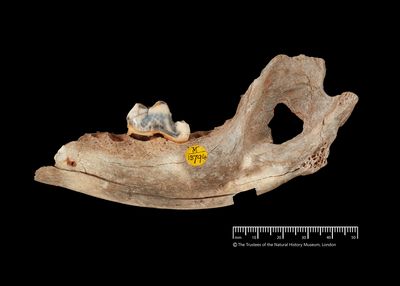
The rest of this article is behind a paywall. Please sign in or subscribe to access the full content.Until recently, the oldest genetic evidence for dog domestication came from a 10,900-year-old site in Russia, yet that record has now been smashed by a recently discovered specimen from Pınarbaşı in Türkiye. Dated to 15,800 years old, this ancient hound is the oldest domesticated dog ever found, indicating that Paleolithic populations already lived alongside canines.
Incredibly, genetic analysis revealed a close relationship between this dog and another that was found at the site of Gough’s Cave in the UK and dated to 14,300 years ago. Together, these findings indicate that a single domesticated dog lineage had already emerged in the Paleolithic and was widespread across Eurasia -–possibly as a result of exchange between culturally distinct groups of hunter-gatherers.
“We applied ancient DNA, radiocarbon dating and isotopic techniques to archaeological specimens from sites in the UK, Central Europe, and Turkey,” study author Dr William Marsh said in a press briefing. “This approach allows us to push back the earliest evidence of dogs by over 5,000 years, with five dogs being identified within the Palaeolithic in these regions between 16,000 and 14,500 years ago.”
One particularly striking finding is that these ancient dogs appear to have been equally popular among Magdalenian hunter-gatherers – such as those from Gough’s Cave – Epigravettian communities in Central Europe, and Anatolian populations further East. And while each of these cultures had its own practices and traditions, dogs seem to have become fully integrated into the lives of all of these Paleolithic groups at a remarkably early juncture.
At Pınarbaşı, for instance, puppies were buried alongside humans while isotopic analyses indicated that dogs consumed a diet of fish – just like their owners. At Gough’s Cave, meanwhile, some deceased humans were subjected to funerary cannibalism, and osteological evidence indicates that dogs may have been treated in a similar way after death.
“This suggests that the kind of personhood that we bestow on dogs was observed by hunter-gatherers 16,000 years ago as well,” said study author Dr Lachie Scarsbrook.

Yet the revelations don’t stop there, as the researchers were also able to confirm that these prehistoric dogs were early members of the so-called western Eurasian lineage, to which many modern dog breeds belong. As such, present-day pooches can now trace their ancestry all the way back to the Paleolithic.
“The ancestry that we detect in the dogs from Pınarbaşı and Gough's Cave has actually made it through the last 16,000 years and ended up in many of the modern European dog breeds that we know and love today – things like the German Shepherd and St. Bernard’s,” explained Scarsbrook.
Building on these findings, the authors of a second study analyzed ancient DNA from 216 canine skeletons from around Europe in order to distinguish which of these belonged to wolves and which to domestic dogs. This led to the discovery of 14 previously unknown dogs dating to both before and after the advent of agriculture.
Examining the DNA of these prehistoric canines, the researchers found that even after the first farmers spread across the region, they didn’t simply replace the local Paleolithic dogs with their own breeds. Instead, agricultural-era dogs continued to receive a significant chunk of their genetic ancestry from more ancient dogs.
“Even to this day, European breed dogs might trace perhaps as much as half of their ancestry back to these dogs that lived in Europe prior to agriculture,” said study author Dr Anders Bergström.
Collectively, these two studies reveal that dog domestication occurred at some point in the Paleolithic, and that the lineage that emerged from this process rapidly spread across Eurasia, becoming fully integrated with multiple prehistoric human cultures. It was this same line of domesticated dogs that then found a role on the earliest farms before giving rise to the various breeds of pet dog that can be found in homes across the world today.
“We call it the Swiss Army dog, because it has adapted to all these different cultural roles that we associate with dogs today and throughout the last 16,000 years,” said Scarsbrook.
The two studies are published in the journal Nature, here and here.